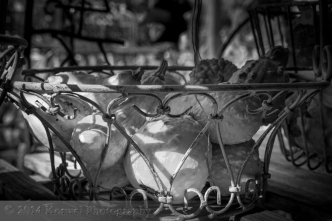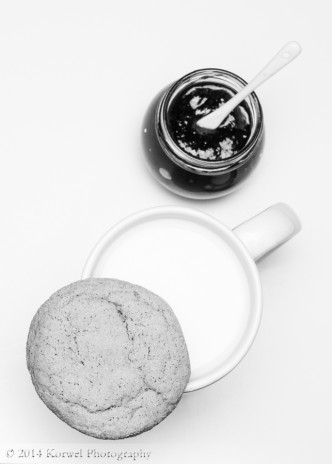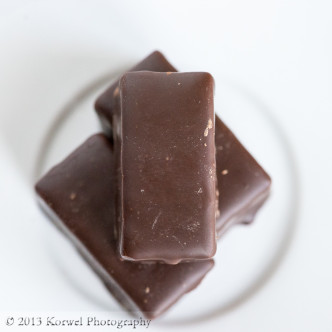
I am discovering, I think, my style in the food photography approach
. I am laughing, because my style means mostly no tripod. The camera on tripod drives me nuts. I want to move around the table, trying different angles, from sides and from lower or higher. The tripod just limits my movements, even as convenient and easy to use as the last one we bought. Yes, in most cases you can adjust it really quickly, you can change the heights by quickly adjusting legs, but for example going from vertical to horizontal and back is major operation. The bottom line- we usually make first shot on tripod, carefully adjusting lights and focal length. When we are happy with this image, the camera goes in hand and everything is possible
. That how I finally ended up with this image, when all the higher angle approches were just not working that well.
| Camera & Lens: NIKON D300 18.0-200.0 mm f/3.5-5.6, Flash fired, compulsory flash mode, return light not detected. | |||||||
| Focal length: | 170 mm | Shutter: | 1/250 sec. | ISO: | 200 | Aperture: | f/11.0 |
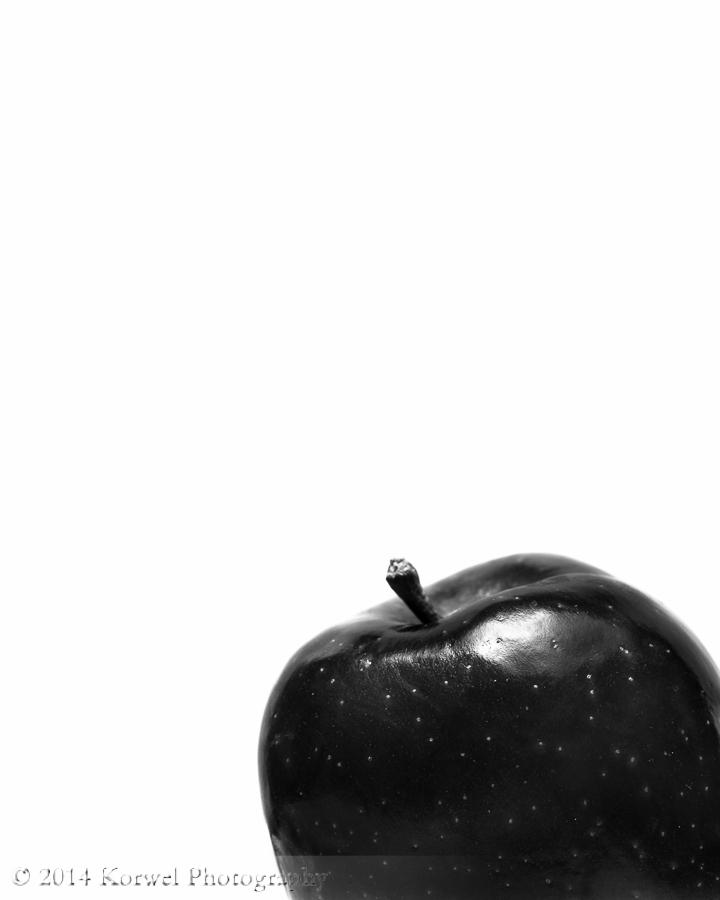
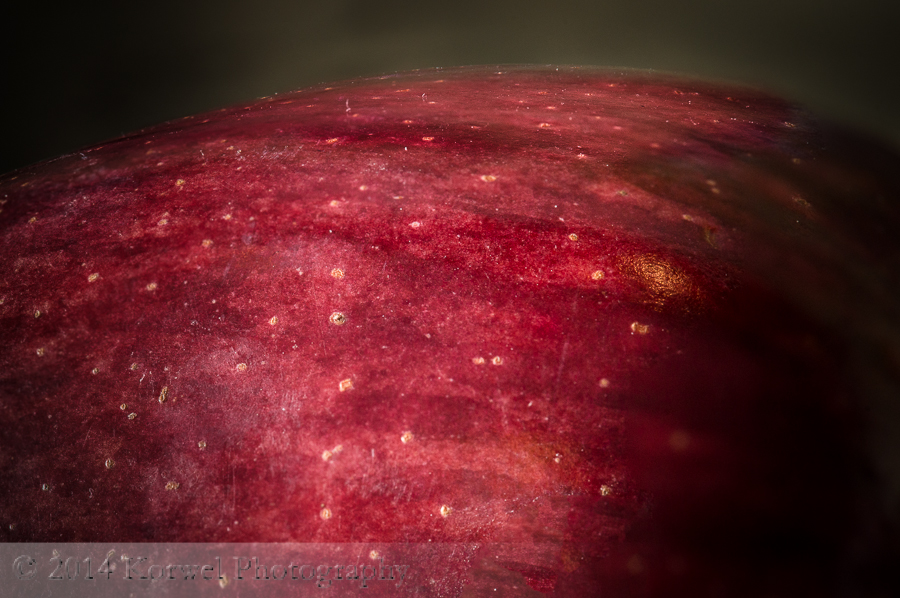
Some more on the subject of fruit and veggies on the white seamless background. I was playing worth matching different fruit with each other, to contrast their colors. The resulting image with an apple looked quite interesting, but how about turning it black and white and adjusting saturation of resulting greys? I think an image looks even better.
| Camera & Lens: NIKON D300 18.0-200.0 mm f/3.5-5.6, Flash fired, compulsory flash mode, return light not detected. | |||||||
| Focal length: | 200 mm | Shutter: | 1/320 sec. | ISO: | 200 | Aperture: | f/11.0 |
There are not many books on food photography. But when you think about, food photography is not different than any other studio-product type of photography. The trick is in knowing how to prepare food for shooting session. I picked up the book “Food photography and styling” by John F. Carafoli from university library. The book isn’t very recent, it was published in 1992. Most of the images in the book are heavily dated, dark lit, white balance is on the side yellowish cast. There are some simple scene lighting schemes presented, but they are not focus of the book. Maybe because the book not written by photographer – the author is an accomplished food stylist. The strength of the book lies in tips and techniques of making food look good on the photograph. Some techniques are already well established in the field, and can be found elsewhere (for example in another good read, Digital Food Photography by Lou Manna). But it is good to know how to make artificial ice cream, so it doesn’t melt on the set; to use margarine because it has better color than butter and to put salami on the pizza when it comes out of the oven, instead of before, because it tends to shrink and change color. The book is full of them, and there is a short glossary of additional advice at the end.
Because the book is written by food stylist, the food images were photographed by people other then author. I was able to find some of the names featured in the book on the Internet and learn more about their work. Jack Richmond seems to have the biggest food portfolio of all of them, it is really worth checking out. Karol Caplan work is more on fine art side, very subtle, but interesting. Brian Hagiwara is a stock photographer with large variety of images, many of them food.
Struggling along with food photography and going beyond plain veggies on white background, we worked with patatoe soup this weekend. I am noticing that I prefer closer, tighter views rather then wide images of the whole set.
We are discovering how many items is enough on the set, and I am very picky in color matching-contrast for those props. I might be on too minimalistic side, but I think I really like simple, light compositions. On the other hand, they might be dated in 10 years
.
| Camera & Lens: NIKON D300 18.0-200.0 mm f/3.5-5.6, Flash fired, compulsory flash mode, return light not detected. | |||||||
| Focal length: | 130 mm | Shutter: | 1/250 sec. | ISO: | 200 | Aperture: | f/6.3 |
My latest submissions to stocks were quite a success. All my images were accepted in Bigstockphoto, and most of the batch got into iStock. Current count is 25 images in Bigstock, 15 images in iStock. I lost with Shutterstock again, and I was really upset. They rejected the images they liked last time, I added them to the batch as sure winners. Well, it is like all the contests and scientific papers, I suppose, it all depends on the person viewing as much as quality of your work, and this time it must have gotten to different checker. I guess what surprised me more was the time it took to process my submissions, I got rejection from Shutterstock right on Sunday, within 24 hours, the BigStockPhoto, as usual, send me comments next business day, and even iStock got me feedback on Tuesday. Must have been slow weekend.
In any case, the number of images we submitted were vegetables on white background, which can have multiple uses for designers. I really like this one, with bunch of asparagus in a glass, they look like mug with pencils on a desk.
| Camera & Lens: NIKON D300 18.0-200.0 mm f/3.5-5.6, Flash fired, compulsory flash mode, return light not detected. | |||||||
| Focal length: | 55 mm | Shutter: | 1/250 sec. | ISO: | 200 | Aperture: | f/11.0 |
Last week’s photo of the set with a bottles of wine got some behind-the-scenes critique. Well deserved, I suppose, it was probably not the most interesting shot. It was busy, but it was supposed to illustrate the point. On the other hand, we were playing with a wine bottle and glass set for a while, it we still cannot master the lighting. On that, and on cherries
. Probably because of all the reflective surfaces. But today’s blog image is one of my favorites so far- although you can see the umbrellas reflecting in the bottle and the glass, it has an elegant feel to it. I like the brown background, and I wormed up the tones a little bit to get this atmosphere.
| Camera & Lens: NIKON D300 18.0-200.0 mm f/3.5-5.6, Flash fired, compulsory flash mode, return light not detected. | |||||||
| Focal length: | 90 mm | Shutter: | 1/250 sec. | ISO: | 200 | Aperture: | f/11.0 |
Another Orton effect. This one was shoot more by accident, when we were photographing pears in downstairs studio. We were trying to get rather shallow depth of field and difference between first and second fruit. Tomasz was manually adjusting the focus, starting from totally unfocused image, which I used as the bottom layer for this “sandwich”.
| Camera & Lens: NIKON D300 30.0 mm f/1.4, Flash fired, compulsory flash mode, return light not detected. | |||||||
| Focal length: | 30 mm | Shutter: | 1/250 sec. | ISO: | 200 | Aperture: | f/2.0 |
In food photography (or for that matter in almost any kind of photography) most of the times the difference between great and so so picture is in second plan. Total image experience is built not only by the main role player but also by all those props that are nicely blurred out by bokeh in the background.
The problem is that building nice second plan set can quickly add to quite an expense. In pursuit to save some green (and any other color for that matter) we decided to go and browse through local thrift stores. I was quite surprised actually how many there are. After spending better part of last Saturday shopping we brought home quite a collection of different things we intend to use in our shots. Here is just a sample (wine is ours
):
And here is the best part of it – all those things cost less than gas we burned to drive to all those stores!
Sometimes best ideas come to me just after we called it a day in the studio and started to put things down. This time was no different. We’ve spent a couple of hours playing with this bunch of tomatoes. But it was when I take our flash case when I saw gel lying there and instantly wanted to play with them a little more. Using 1/3ev orange filter on key light made tomatoes look like they were catching some morning light. I like this one the best from the whole series.
| Camera & Lens: NIKON D300 18.0-200.0 mm f/3.5-5.6, Flash fired, compulsory flash mode, return light not detected. | |||||||
| Focal length: | 200 mm | Shutter: | 1/250 sec. | ISO: | 200 | Aperture: | f/7.1 |