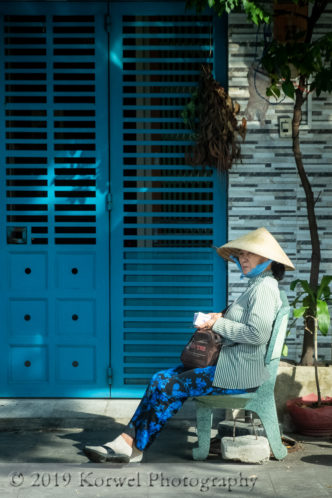

Another DPS monthly critique and edit challenge. Another picture not taken by me, only edited by me. This time, the task was far more difficult for me to approach, as on the first glance, I didn’t like the image at all. What was bothering me were the hanging pieces of fabric, worn and far too colorful to my taste. However, I operated under the assumption that they are there for a reason, and decided to go with them. Mostly because cloning them out requires too much patience, which I don’t have ;) .

I looked at different cropping though,  and decided to put more focus on sky and the far right, highest peak. The easiest way to do it was to make it portrait. I opened shadows by making a the single image-HDR, and added a lot of blacks to recover lost contrast. A bit of vignette to put focus on snow-covered mountain and rags. The final touch was to lower saturation of reds (-67, not too much), which made the colorful rags less distracting.

Camera & Lens: Canon EOS 5D ,
Focal length: 70 mm Shutter: 1/200 sec. ISO: 50 Aperture: f/9.0

Posted by Izabela, filed under Lansdscape. Date: February 8, 2010, 8:53 am | No Comments »

I found several show-worthy images in my Konica Minolta collection from Vancouver, 3 years ago. This one was improved using the Contrast Layer Mask, as shown in this great video tutorial. Photographing sunset in Vancouver is not an easy task, because…. It is not positioned on the open Ocean. There are mountains, islands and bunch of other stuff, obstructing the view. So, you need to be creative.

Camera & Lens: DiMAGE Z2 , Flash did not fire, compulsory flash mode.
Focal length: 58.7 mm Shutter: 1/60 sec. ISO: 50 Aperture: f/8.0

Posted by Izabela, filed under Lansdscape. Date: February 7, 2010, 9:14 am | No Comments »

Several weeks ago, I was lucky winner of a signed copy of Jeff Revell “Nikon D5000 From snapshots to great shots” in Twitter contest. My husband was giving me hard time about it, as I do not have and probably will never have Nikon 5000. As an excuse, let me just mention that his brother got Nikon 5000 not so long ago. But since I  had a book at hand, I decided to read it and review it. Interestingly, I really enjoyed it, even though I new most of the stuff.  Additionally, I learned some stuff I could use in my D300 and some stuff I could use in my D40x ;) (I know, but I am such no-read-manuals person).

What makes the book such a good read is the fact that it is written in plain English, easily understandable. Important for somebody who is not a native speaker. Plus, it is certainly not a manual. It is so much more. What the book does, is introduces you to all the basics concepts of digital photography, at the same time familiarizing you with how to set your camera (in this case Nikon D5000) to try doing those things yourself. It talks about exposure, shutter speed and aperture, and how they effect action and depth of field in your images, while pointing you at the settings in your camera. It also talks about more advanced stuff, like Hyperfocal Distance, shows how to make HDR images or panoramas. The pointers for taking sports, landscape and portraits are given in detail. Some basic composition tips are included, as well as using on camera flash. And the video feature is discussed in bonus chapter ;) . As far as I can tell, nothing is missing!

The book is something I had available when I got my first dSLR. I was not familiar with any of the photo lingo, like Exposure Compensation or Rule of Thirds . I was reading the handbooks for the beginners, learning the basics, while at the same time having to consult the manual how to set things in my Nikon D40x (and learning what is possible and what is not). “From snapshots to great shots” provides both at the same time. It brings you up to speed with the secrets of good photography at now time.

My favorite part of the book were “Poring over the picture”. I enjoy this type of teaching experience, where the photograph is explained, how was it taken and why this way, plus the images were great as well (and large, large!). I think that the paper quality or texture did not do them the justice, sometimes the colors were not properly rendered.

Overall- good idea for beginners getting their new DSLR – not only D5000. The series includes Canon 50D,Canon Rebel T1i/500D, and Nikon 3000 is already in writing.

Posted by Izabela, filed under Remarks. Date: February 6, 2010, 8:55 am | No Comments »

05  Feb
Blackberry cereal

Another shot from the studio session with two flashes and corn flakes. And another shot from having fun with macro set for Lensbaby.

Camera & Lens: NIKON D300 0.0 mm f/0.0, Flash fired, compulsory flash mode, return light not detected.
Focal length: 50 mm Shutter: 1/160 sec. ISO: 200 Aperture: f/8.0

Posted by Izabela, filed under Food. Date: February 5, 2010, 8:54 am | No Comments »

04  Feb
Rim light

Recently I find myself trying more and more different kind of lighting pattern I’d like to learn and trying them at our small studio. During last week all we shoot is food so this time you’ll get a nice apple:

Apple on wine glass

Camera & Lens: NIKON D300 18.0-200.0 mm f/3.5-5.6, Flash fired, compulsory flash mode, return light not detected.
Focal length: 130 mm Shutter: 1/250 sec. ISO: 200 Aperture: f/14.0

The apple is being lit by one umbrella dressed Speedlight to the right of the camera and another one zoomed out to 85 mm to the back left to produce this nice rim effect on the left. Water droplets just made the effect more pronounced.

Posted by Tomasz, filed under Food. Date: February 4, 2010, 8:20 am | No Comments »

03  Feb
Flasks

I am treating my photography seriously for what? Two years now? And for about that long I am just pondering on the idea of shooting what I know the best- my work place. What makes my work place so interesting, is the fact that I work in the lab. Think chemistry. Which sometimes means stink, but most of the time- it means a lot of objects, a lot of glass. Usually in the afternoon, when sun gets to the side of the lab where the sole window is located, it would shine straight on my bench where all the solutions stand in their glass flasks. I have been looking and thinking to photograph it for some time, but this time I finally took out my iPhone and snapped few images. This is my favorite.


Posted by Izabela, filed under Interior. Date: February 3, 2010, 8:45 am | No Comments »

Taking quite a number of studio food images recently, we constantly stumble upon need of macro lens. Neither of our lenses are macro model nor can we afford new one just for fun. So I started exploring topic of extension tubes. All comes to three choices. Use the Nikon original ones that preserve full functionality of your lenses but cost pretty much similar amount of money to some used macro lenses. Or you can buy cheap extension tubes from eBay that cost next to nothing but provide no connection connection what so ever. That pretty much rules out all those newer lenses that don’t have aperture ring. There is a company called Kenko that makes cheaper versions of those tubes that work but they ain’t cheap either.

For quite some time I was planning to buy the Kenko but one day something got me thinking. Sometwhere deep in the back of my mind there was a thought that we have a teleconverter bought on eBay about 2 years ago that we pretty much never use due to it’s lousy performance:

How about trying to take the glass elements out of it and use it as a macro extension tube?

Looking closer at the lens I noticed that the glass is held in the converter by small nut-like ring:

You can barely see on above picture. 10 seconds with screw driver and the glass elements (yes, there are three glass elements inside) were out:

The results? Working macro extension tube providing both electrical connection between body and lens as well as mechanical coupling for the aperture and auto focus. I tried it with our 18-200 zoom and here is one quick and dirty picture taken with the tube on:


This picture was taken from the distance about 5 inches from the ring. And imagine that – both autofocus and TTL worked as there was noting there.

There is only one slight problem with the extension tube – it’s quite thick, meaning that it’s a really macro-macro tube. But for $40 (that’s what I recall we paid for the converter we never used) you can’t really complain.


Posted by Tomasz, filed under Remarks. Date: February 2, 2010, 8:00 am | No Comments »

January was my months of stock submissions. I was trying 3 agencies, although I am not sure if I will continue this way, or just decide on one. I think this article really made me think a bit more about what business plan I want to pursue with my stock submissions. Having same image in different agencies at different price probably won’t do me any good….
Meantime, a week after my first 3 images were not worm received, I submitted another 3 images for initial approval in iStock. They were accepted, now I have a green light to submit. I was a bit afraid to submit any more, for I thought about their high standards, but hey, I need to try. I submitted first batch of 12 photos. Almost a week passed from my submission, I expect to hear from them any day now. On the side note,
I also signed up and submitted initial 10 images for Shutterstock. All but three were found acceptable (they rejected for example my favorite “White breakfast“, due to poor light, interestingly, this image was found acceptable in both iStock and BigStockPhoto!). You need to submit at least seven good in your first ten before they let you start for real. Bottom line? I can try again after 30 days. I have those 3 ready for then :) .
Meantime, I was continuing more or less regular submission to BigStockPhoto, with changing luck. Some submissions were perfect (5/5), some far less (4/10). Overall, I have a growing portfolio with them.

All in all, this is still just a submit/get accepted game, but I have to start thinking what to shoot to actually get somebody to buy my images.

Posted by Izabela, filed under Remarks. Date: February 1, 2010, 8:08 am | No Comments »

My husband and I were visiting Canada some 3 years ago. We stayed there for a month, and although I was working on a scientific project, I was not working on the weekends and afternoons. Having a car, it was a great chance to get to know the region, and we took a whole advantage of it. We visited Vancouver, and took a ferry to Vancouver Island. On one of the weekends, we drove thew Sea to Sky Highway up to Whistler, where they just started to work on the Olympic Village. On the way back, we saw this beautiful waterfall from the road. It was impressive. It looked to me like it is starting at the top of the mountain. We stopped and took some photographs from close-by, but I still think it looked better from the distance.

Camera & Lens: DiMAGE Z2 , Flash did not fire, compulsory flash mode.
Focal length: 6.3 mm Shutter: 1/200 sec. ISO: 50 Aperture: f/5.6

Posted by Izabela, filed under Lansdscape. Date: January 31, 2010, 9:08 am | No Comments »

30  Jan
Gerbera and lemon

Today’s image comes from the same session Tomasz mentioned several days ago. We were finishing off our evening in the studio, when I thought- how about paring a yellow gerbera with a yellow lemon? He was not very convinced at first, and when I set it up and took several images, I was not so sure myself. But it somehow transformed on the screen into quite an interesting still life.

Camera & Lens: NIKON D300 0.0 mm f/0.0, Flash fired, compulsory flash mode, return light not detected.
Focal length: 50 mm Shutter: 1/320 sec. ISO: 200 Aperture: f/5.6

Posted by Izabela, filed under Food, Plants and flowers. Date: January 30, 2010, 8:19 am | No Comments »

« Previous Entries